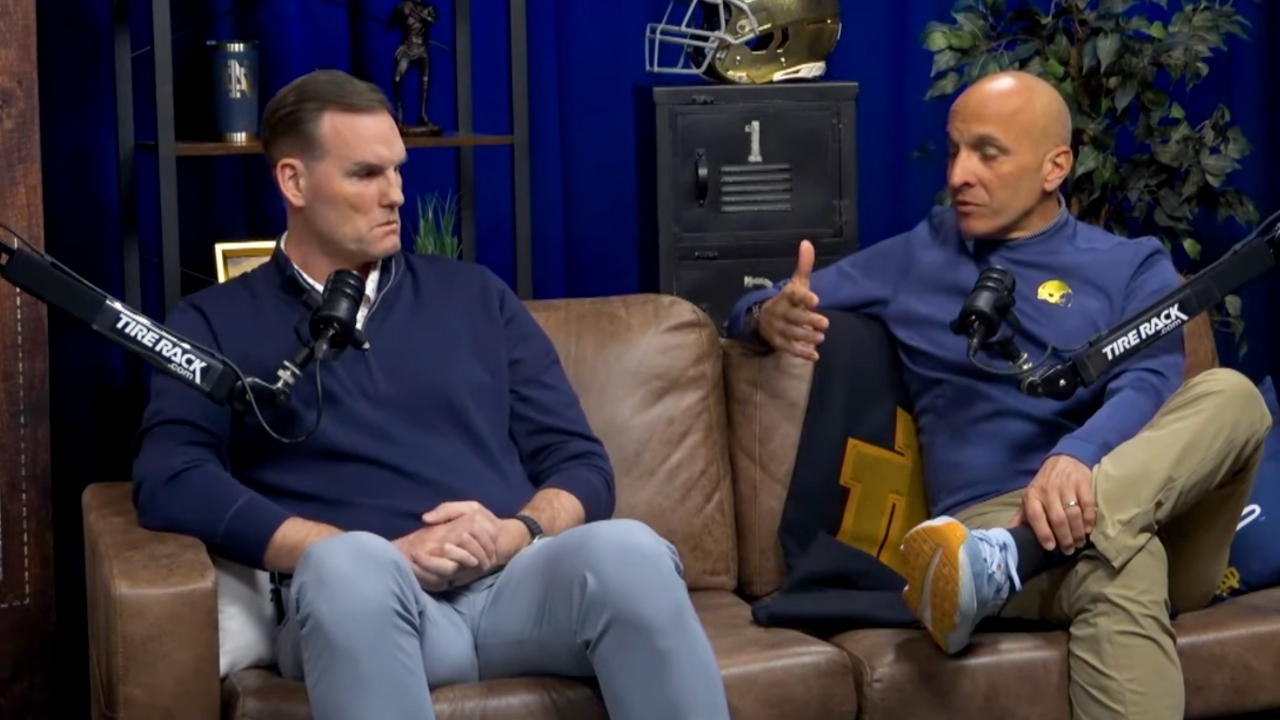
Notre Dame athletic director Pete Bevacqua and basketball general manager Pat Garrity sat down on the university’s in-house podcast, Wake Up the Echoes, this week.
They covered a wide range of topics, which shed light on how Notre Dame is building and maintaining its athletic programs in an ever-changing landscape.
On where Notre Dame is positioned in the new era of college athletics:
Bevacqua: I think we're certainly positioned well, but you said 10 to 15 years. I think things have changed so dramatically in the last two years. When you think about really that defining moment of the lead up to the house settlement and the house settlement, and now the implementation of it. It's changing. It's no exaggeration. It's changing week by week. I think the advantage that we have kind of goes back to what Pat was saying of why he chose Notre Dame or a place like Stanford, two of the best schools in the country.
We know what our North Star is, right? Regardless of the noise that's going on around us, we're going to have an authentic, credible student athlete experience. When you come here, we're going to give you everything you need and every advantage you can possibly have from an athletic standpoint, but we're going to do the same academically. Not everybody can be a first round draft pick in the NBA and play in the NBA. Those people are few and far between.
The vast majority of our 740 student athletes, their athletic experience is important, but getting that Notre Dame education, that Notre Dame degree, becoming part of the Notre Dame family is really what is going to serve them so well for the rest of their lives. And even those who make it, the Pat Garrity's, you think about a Jeremiyah Love, a Jadarian Price guys that are going to go into the NFL draft this year and hopefully have wonderful success in the NFL. But even when you make it in the NFL, the WNBA, the NBA, the NHL, when you retire, when your career ends, you're still going to be a young person and you're still going to have your whole life ahead of you.
And it's that Notre Dame degree. When we're talking to recruits and we're talking to our current student athletes, that's, that's the Notre Dame promise. That's why we say it's a four forever decision because it's that becoming part of the Notre Dame family and choosing hard as, as Marcus (Freeman) says, that’s the key here.
But we can't bury our heads in the sand. We have to do what we need to do to stay ultra-competitive in this landscape. That is being aggressive and progressive and making sure we know what we're doing with name, image, and likeness. Pat runs that team with Ron Powlus and making sure that we're out there going toe to toe with other major programs in our 26 sports. That's key for us, but never losing sight of that North Star that you come to Notre Dame, not just to be an athlete, but to be a student-athlete.
On the biggest challenge being a General Manager and leading the NIL group:
Garrity: There's two main things and it's helpful to compare the way that professional sports at my experiences in the NBA with how it works. So in the NBA, there's a salary cap, there are rules to go over the salary cap. Everybody knows what everyone else spends. There's a system where you can kind of click in and look at the contract down to incentive levels, salary protection levels, and the contracts are really not that flexible. There are certain sections that you can either add or remove, but there's no changing the language at all. So there's just a standardization and everybody knows there's like total transparency in the market.
It's the exact opposite in college sports. There's no transparency at all in what it even takes to field an NCAA tournament-level basketball team at the Power Four level. The way that we're coming up with that is people are all kind of talking to each other, sometimes lying to each other sometimes, but trying to piece it all together that way. You don't even really know what is required to compete at that level. We have over time you get a good idea, you have a range that you think, and then when it comes down to negotiating these deals with individual athletes, there's part that can be contracted, there's part that can't be contracted. Every school is approaching it a little bit differently.
When you're talking to either a parent or an intermediary area that's working with the student there, they got one offer what they think at one school that does it one way, and we do it another way, and a third school is going to do it a third way. It's just a giant coordination problem in how you actually get to a deal. So that presents one set of problems just to get to a simple one-year deal.
When you start trying to think about how do we protect ourselves, add some upside, but protect ourselves, adding mechanisms to a contract, it just gets really hard to get anything creative done.
Bevacqua: I think the key for us and the advantage we have in Notre Dame is when these young men and women come to Notre Dame to be a part of the Notre Dame community and to be a student athlete, they become embedded in what Notre Dame is. Not a hundred times out of a hundred, but the vast majority because so much of it is transactional now out there.
If I was running an NBA team and Pat was a power forward and I was running the New York Knicks, he couldn't walk into my office on a Tuesday and say, hey, you know what, I decided I'm going to go play for the 76ers. Well, Pat, no, you have a contract. You can't do that. That team can't take you.
College sports, there aren't those rules. It's not really a two-way street. We have to do what's best for our student-athletes. That's why we're here, but we also have to protect the university. A lot of what that entails is making sure you get the right type of person that young student athlete who comes here for more than just playing the sport. To be a part of Notre Dame, to get this Notre Dame education, the bonds that those student athletes form with their head coaches, with their teammates, their classmates, that to me is going to be one of the great advantages we have here at Notre Dame, because it's deeper than just playing the sport.
On if the NIL guidelines will become clearer in the future:
Bevacqua: When we talk about this, I mean, literally every day, first of all, there have, there has to be rules or has to be regulations, but they have to be realistic. My personal belief is that the cap coming out of the house settlement is probably too low. I’ve said that. I think it needs to be adjusted. I think Notre Dame has always been a proponent of making sure that student athletes are compensated once it was allowed, correctly and fairly.
Where the rules have to be is, OK, if we're going to make a huge investment in a student athlete, particularly around a handful of sports, right? It's football, it's men's and women's basketball, it's hockey and it's other sports, but the primary sports where you're seeing these large compensation deals are primarily football and men's and women's basketball, but it has to be more of a two-way street with the rules and other colleges their feet have to be held to the fire as do ours, as do the student athletes because right now there's rules.
They're a bit ambiguous. They're a bit amorphous. I think a lot of the tenants of the house settlement, and we're huge proponents of the house settlement, but even roughly a year since it's been approved, I think we're realizing a lot of components of it just don't work because they're not realistic.
I think we need to go into this with a real heavy dose of realism and it will plateau out. There will become a market value. What does it mean to be a starting quarterback at a major university with a major football program? What does it mean to be a starting point guard on the men's or women's basketball team? I think like professional sports, this will level out. I just don't think we're there yet.
On if he agrees the landscape will even out:
Garrity: Yeah, no. I think maybe it's like a distinction that doesn't really matter, but there are rules right now that have been communicated to us. In the first year, obviously, there's going to be some working out and things that weren't contemplated that the NCAA or the CSC has to provide guidance on. The big question is of enforcement right now and whether or not any of the rules will be enforced and if it's even legal to enforce some of the rules, because I think what everyone anticipates is when there is the first enforcement action, it'll be taken to court and the courts will decide.
Going back to the comparison to professional sports, there's just not that thought. Like the idea of tampering in the NBA, like no one would think to do it because the penalties, the precedent has been set and the penalties are so harsh. It was in the news, the situation like with the Clippers and Kawhi (Leonard), and whether or not that's still kind of going through the investigation, but like that's not at all prevalent because everyone's agreed upon these set of rules and the penalties for violating them are so harsh.
I think that's the big question mark here in college sports is when will enforcement happen? Will it happen? And if it does happen, will it be challenged or will that challenge be successful?
Bevacqua: The tricky thing here is when you think about the major professional sports, whether it's the NFL, the NBA, let's focus on those two particularly, the WNBA, sure, that as well, but they're structured to create equality. Whether in certain sports, it's a salary cap. You think about the draft, you think about the schedule from one year to the next, right? You can't really do that in college sports.
The concept of, OK, well, we want to have a great equalizer, whether it's a compensation or you can't say to somebody, OK, well, you finished last in the Big 10. So you're going to be able to go out there and get the top quarterback next year because you can't tell a 17-year-old, 18-year-old kid, hey, now, you know what, your rights were picked up by school X or school Y because maybe he dreamed of going to Notre Dame or Stanford or some other school his entire life. There's also that inconsistency that professional sports want to achieve maximum equality because it makes their product great.
You saw that even with the NFL playoffs, the chance that, OK, if you have a horrible season, you're going to get the first draft pick and you're going to be able to go get that person and maybe he can change your program around. College, like, we're not striving for equality. We're actually trying to be as dominant as we can, and that’s a counter purpose as well.
On how it’s hard for fans to keep track of who is on the roster and if the old days of players staying at one school is preservable while being competitive:
Garrity: I hear that too anecdotally and then at the same time, I think you see ratings for some of the big college football games. I think this college basketball season has been outstanding. The coverage that it's getting, the interest that it's getting, like that doesn't seem to square with what a lot of people say of like throwing their hands up.
I've had friends say it too, like, I'm just going to watch the NFL now. I don't know who's on my team anymore. One of the other things, and I'm looking more this kind of like internally, one of the more difficult things is like, how do you kind of establish and communicate and build a culture over time, right? Because like the way you traditionally do that, and your culture is not only kind of like the Notre Dame basketball team, but it's like you also want to have elements of the broader Notre Dame culture in that.
How do you do that when someone is here for eight or 10 months? How do you even evaluate a coach and how do you evaluate the way they're approaching player development if there's so much turnover, right? Like that's to me, it's like, it just becomes, you evaluate like the wins and losses at that point. But do you really even know that point? Are you evaluating like your ability to go and like source talent, right?
Bevacqua: If Niele (Ivey) or Micah (Shrewsberry) or Marcus were sitting here, or Brock (Sheahan) or any of our coaches, but particularly those where the transfer portal around the nation is so prevalent. They all realize that at Notre Dame, you're not going to major in the transfer portal. You have to be selective, you have to be opportunistic, but the bread and butter of the Notre Dame programs is recruiting high school student athletes that excel in their sport and want to come to Notre Dame. First and foremost.
Now, you can't turn a blind eye to the transfer portal, you'll be left in the dust. You have to fill needs and go out there and try to recruit those types of people who can come here and be advantageous for the team, but also fit into the Notre Dame student-athlete fabric. I think that is critical.
I do think to your point though, and Pat's right on the ratings, college sports have never been more popular. College football is the second biggest thing in media by a mile, really second only to the NFL, which is at the top of the mountain.
If being a student athlete and joining a college program, if there's an educational component to it, which there has to be, certainly here at Notre Dame, if you're going to four different schools in four years or five different schools, I just think the credibility of the educational experience, it becomes a farce.
I remember Pat and I were sitting at one of the men's basketball games early in the year, and I won't mention the team, but I said, well, that kid's really good and Pat's like, this is his fifth school. He's kind of bounced around from school to school to school.
What is the end result for that person, that young man or young woman? If you're going to four schools in four years, it probably means you're not taking the next step and going to the NFL or the NBA or the WNBA. It probably means you're not getting an education. It probably means you're going to finish your college experience without getting a degree. And maybe you patch together what at the time seems like meaningful compensation over that very disjointed journey, but you're going to burn through that money. You're going to wake up and be 24, 25 years old without a college degree, without a spot in the NFL or the NBA and then what?
That's the promise we make. Where's home? It's like, hey, listen, we hope everybody on our team can go play professionally in the WNBA, the NBA, the NHL, the NFL, but that's not reality. You can leave here with a Notre Dame degree and chase your dream. If you make it wonderful, nobody will be more excited than we will.
If you don't, we're not going to leave you in the lurch. You're going to leave here with that Notre Dame degree and that means a lot. It doesn't resonate with everybody. That's why not everybody comes to Notre Dame, but for the kids who come here, they and their families tend to grasp that.
Want the latest scoop on the Fighting Irish? Sign up for our newsletter and become an ISD Premium Subscriber: Sign Up for ISD
Notre Dame Fighting Irish Cutter & Buck Cascade Sherpa Fleece Full-Zip Vest