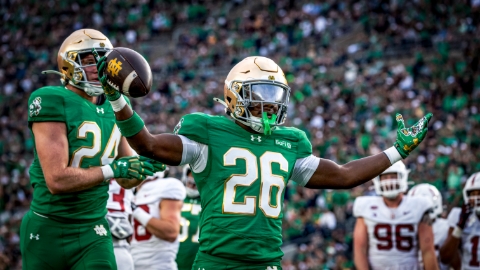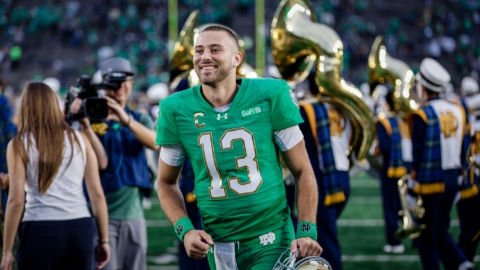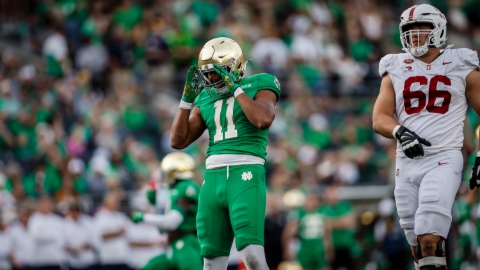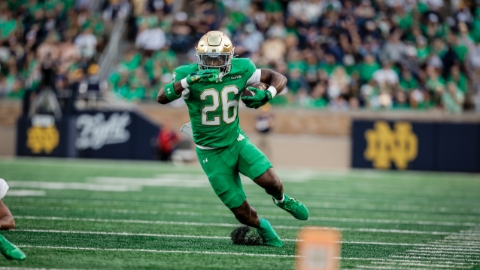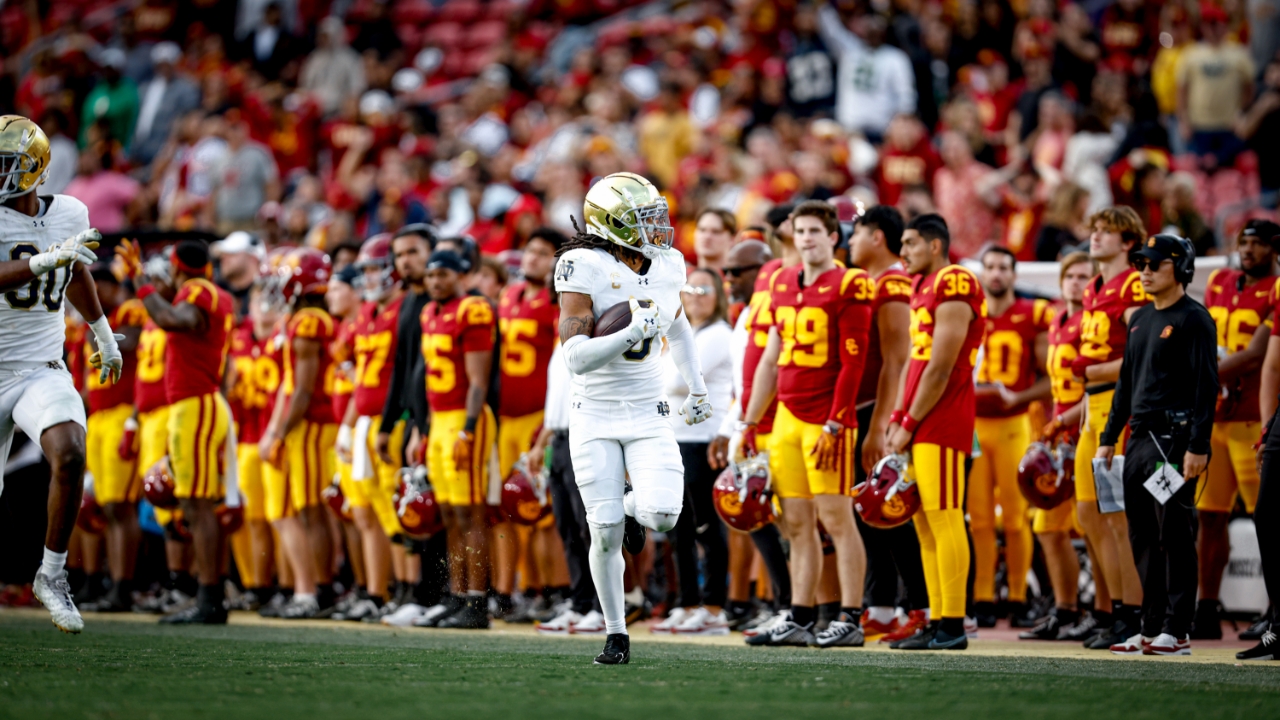
Notre Dame playing USC is a win for everyone.
The players win. Current students win. Alumni win. Fans from both schools win. College football wins.
It’s the colors. It’s the history. It’s tradition. It’s everything that makes the sport special.
For both schools to come together and agree to a four-game home-and-home series is a step in the right direction. After months of Notre Dame and USC pointing fingers over who was responsible for the rivalry’s temporary demise, it’s ironic Indiana ended up taking the biggest hit from Monday’s announcement.
At the end of the day, I don’t fault either school for holding firm in its position on the rivalry. Notre Dame has reached the point where the program enters every season with legitimate national championship aspirations, while college football’s financial greed has put USC in a difficult scheduling position.
Having the rivalry open the season is fascinating. The stakes immediately feel higher, but if college football has expanded to a 24-team playoff by 2030, an opening-week loss may not carry nearly the weight it once did.
The anticipation every August will be on another level. Fans already spend the offseason counting down to fall camp. Imagine adding Notre Dame-USC in Week 1.
From a scheduling standpoint, the move benefits USC a bit more than Notre Dame. The positive for both teams is that the road team can schedule at least one home game over the following weeks to settle back into a routine.
It’s also hard to blame USC for wanting to move the game from its traditional spot on the calendar. In 2026, the Trojans will play road games at Rutgers, Penn State, Wisconsin, Indiana and UCLA. That’s four trips to the Eastern Time Zone and it would have been five with Notre Dame. That’s simply too much travel for college athletes.
The Irish have had their share of scheduling blunders, but they’ve never scheduled five games on Pacific Time.
Still, you don’t end one of college football’s greatest rivalries, and USC chose to do exactly that.
USC ultimately got what it wanted by moving the game before Big Ten play. In the process, the rivalry loses some of the magic that came with USC visiting South Bend on a crisp fall evening or Notre Dame making its annual trip to the Coliseum with everything on the line in late November.
Regardless, the rivalry is back. That’s a victory for a sport that too often prioritizes television contracts and revenue over tradition.
Looking ahead, Notre Dame’s 2030 schedule is shaping up to be outstanding. As of now, the Irish are scheduled to open the season at USC on Aug. 31 before traveling to Alabama on Sept. 14. Clemson is also set to visit South Bend on Oct. 19. That’s the kind of schedule college football fans want to see.
Despite the game being four years away, recruiting wins will still matter as the 2027, 2028 and 2029 classes will make up the majority of the players on the field when the rivalry resumes.
There haven’t been too many head-to-head battles between Notre Dame and USC as the Trojans have focused on Southern California and the Irish have been picky in the region. But after a short break, both fanbases can start tracking recruiting additions, and those head-to-head battles will once again matter just a little bit more.
That brings us to Indiana.
It didn’t take long for reports to surface Monday that Notre Dame’s two-game home-and-home series with the Hoosiers would be canceled. Given the opportunity to replace Indiana with USC, the decision made perfect sense for Notre Dame.
Indiana and Curt Cignetti deserve tremendous credit for orchestrating one of the most impressive turnarounds in college football. But the Hoosiers aren’t acting like a program determined to establish itself among the nation’s elite.
Instead of embracing bigger challenges and creating more marquee matchups, Indiana appears perfectly content scheduling the easiest possible path back to the College Football Playoff.
The Hoosiers have now canceled three series against Power Four opponents. Louisville, Notre Dame and Virginia were all scheduled to face Indiana before the Hoosiers backed out.
Had this happened when Indiana was coming off a 3-9 season, nobody would have cared. Programs in rebuilding mode make scheduling decisions like that all the time.
That’s no longer the case.
Yes, the Big Ten is demanding, and Indiana will still have to earn its way into the CFP. But Cignetti has also discovered that one way to maximize those odds is by removing virtually every challenge from the non-conference schedule.
In fact, Indiana is now the only Power Four program in the country without another Power Four opponent on a future non-conference schedule.
2026: North Texas, Howard and Western Kentucky
2027: Kennesaw State, Indiana State and UMass
2028: Austin Peay, Eastern Michigan and Miami (OH)
2029: Ball State, Eastern Illinois, Western Kentucky
2030: Indiana State and Delaware
2032: UConn
I think most can admit that on paper Notre Dame’s schedule lacks the normal firepower, but it’s also not in Indiana’s league.
Every program deserves a tune-up game or two. That isn’t the issue.
The issue is that Indiana has built an entire non-conference philosophy around avoiding meaningful games.
In an era where the sport is losing its traditions, Notre Dame and USC deserve credit for preserving one. Indiana deserves criticism for moving in the opposite direction.
Want the latest scoop on Notre Dame Football and Recruiting? Sign up for our newsletter and become an ISD Premium Subscriber: Sign Up for ISD
Notre Dame Fighting Irish 22oz. Stadium Tumbler