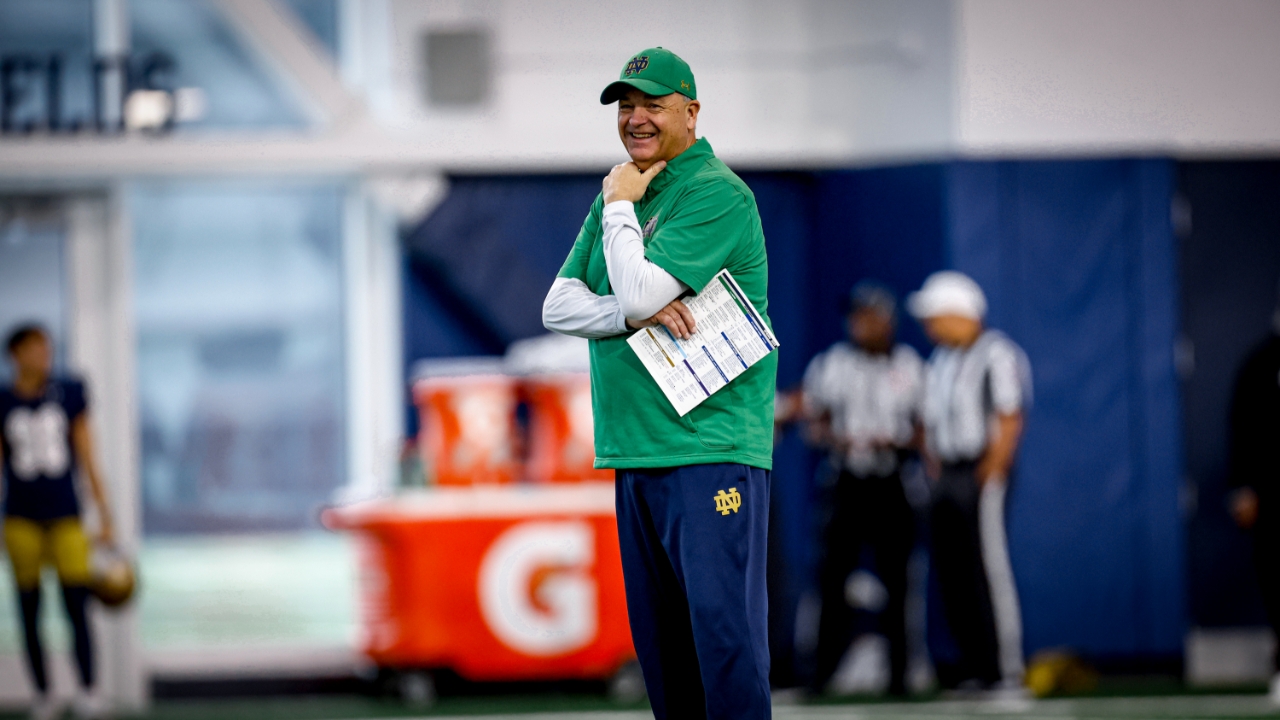
Notre Dame’s offense has put points on the board in 2026.
Mike Denbrock’s offense is averaging 41.2 points per game, and perhaps the most exciting part of the equation is that the Irish haven’t come close to peaking.
The run game showed signs of life last weekend in Chapel Hill as Notre Dame rushed for 241 yards, while CJ Carr threw four touchdown passes.
The growing pains on offense might have some frustrated fans, but Denbrock expected them while breaking in a new offensive line.
“I thought this was just going to be a little bit of a work in progress, especially with the run game,” Denbrock said. “When you really look at offensive line-wise, how many starts does [Will] Black have at left tackle? [Anthonie] Knapp, how many starts does he have at left guard? How many starts does Guerby Lambert have at right tackle?”
Sure, Notre Dame has plenty of experience returning, but only center Ashton Craig had taken meaningful game reps at his current position before the season.
Denbrock believes last weekend could be a turning point for the Irish offense, as he has seen steady progress throughout the year.
“I think we've continued to make a little progress every week,” explained Denbrock. “It may not be as fast as some people may like it, but I'm happy with where we're headed and really the response that they've had week to week about getting better at some of the little things. It showed up in
Scoring points is important, as the team with the most points wins games.
But Denbrock is looking at Notre Dame’s success in situational football to determine how his offense stacks up against others around the country.
The area he wants to improve right now is third-down conversions. Notre Dame ranks No. 77 nationally, converting 40.38 percent of its third downs.
“We're below it,” Denbrock stated. “Some of that is offset a little bit by how we call the game on third down, knowing we're going to go for it on fourth down. But still, third-and-mediums, we've got to be better there.
“We've got to get to a position where we are a little more automatic in those situations and we haven't done as good a job in those areas as I'd like us to do.”
Denbrock would also like to see Notre Dame improve its red-zone efficiency.
The Irish have scored on 91.6 percent of their red-zone trips, including 16 touchdowns.
One of those empty trips came in Chapel Hill, where Notre Dame was stopped on fourth-and-goal. The stop set up a 97-yard North Carolina drive that allowed the Tar Heels to pull within one score just before halftime.
Denbrock’s third-down play call has taken some heat over the last week after he called an outside run for Carr, who was stopped for a loss. A week earlier, Notre Dame had scored on a similar play against Purdue.
“Maybe if we execute the play that was called, we walk in the end zone just like we did against Purdue,” explained Denbrock. “We didn't execute it very well. That means it's a bad call.”
Of course, if tight end Ty Washington had secured his block, Carr might have walked into the end zone, and Notre Dame message boards would have been praising Denbrock for picking the right time to run his quarterback.
But the missed opportunity wasn't simply a matter of Washington's missed block. Starting left guard Anthonie Knapp was out for the play, forcing sophomore Cam Herron to take his first rep in a high-pressure situation. That personnel change also factored into Denbrock's thinking.
“When it doesn't work, I'm like in between series, ‘What the f*ck are you doing,’” said Denbrock. “That's human nature. Listen, scenarios are running through my mind like every second. When you're in the moment, of course, no, I'm not thinking about that. When they've got the ball and — I had some time to think and it was kind of like, ‘I should have just called the guard-pull power play we had regardless of who the guard was. I didn't do it and I can't take it back.”
Denbrock also took aim at Pro Football Focus' statistics, specifically its tracking of play-action passes.
PFF has Denbrock using play action on 15.5 percent of Carr's dropbacks, but Notre Dame's offensive coordinator disputes that figure.
“I would argue with Pro Football Focus and their numbers based on what the hell do they know whether it's play action or not,” stated Denbrock. “Are they talking about straight naked bootleg? Are they talking about flash action to the back? Are they talking about us chipping out? What exactly are the parameters they're using to come up with their 15%?”
Denbrock estimates that Notre Dame uses some variation of play action on approximately 25-30 percent of its passing plays.
Regardless of how often the Irish use play action, Notre Dame needs its run game to perform like it did against North Carolina.
Freshman running back Jonaz Walton could be a significant part of that equation after rushing for more than 100 yards in his first extended game action.
Walton's success didn't surprise Denbrock, who saw the Georgia native trending in the right direction during fall camp.
“We all kind of looked at how he went through fall camp, and it was like the times where we put him in critical situations, it didn't seem too big for him,” Denbrock explained. “He wasn't out of his element. I think his comfort level continued to rise as the season kind of went along.”
Denbrock knew Walton's role would increase last weekend, but he probably didn't have the freshman carrying the ball 12 times on a single drive written into his play sheet.
“We really were trying to be intentional about getting him a little more involved and then last week the opportunity presented itself for that to be a reality,” said Denbrock. “He absolutely obviously took advantage of it.”
Want the latest scoop on Notre Dame Football and Recruiting? Become an ISD Premium Subscriber and never miss the inside information. Sign Up for ISD
Notre Dame Fighting Irish League Collegiate Wear Guinness Toucan Tri-Blend T-Shirt