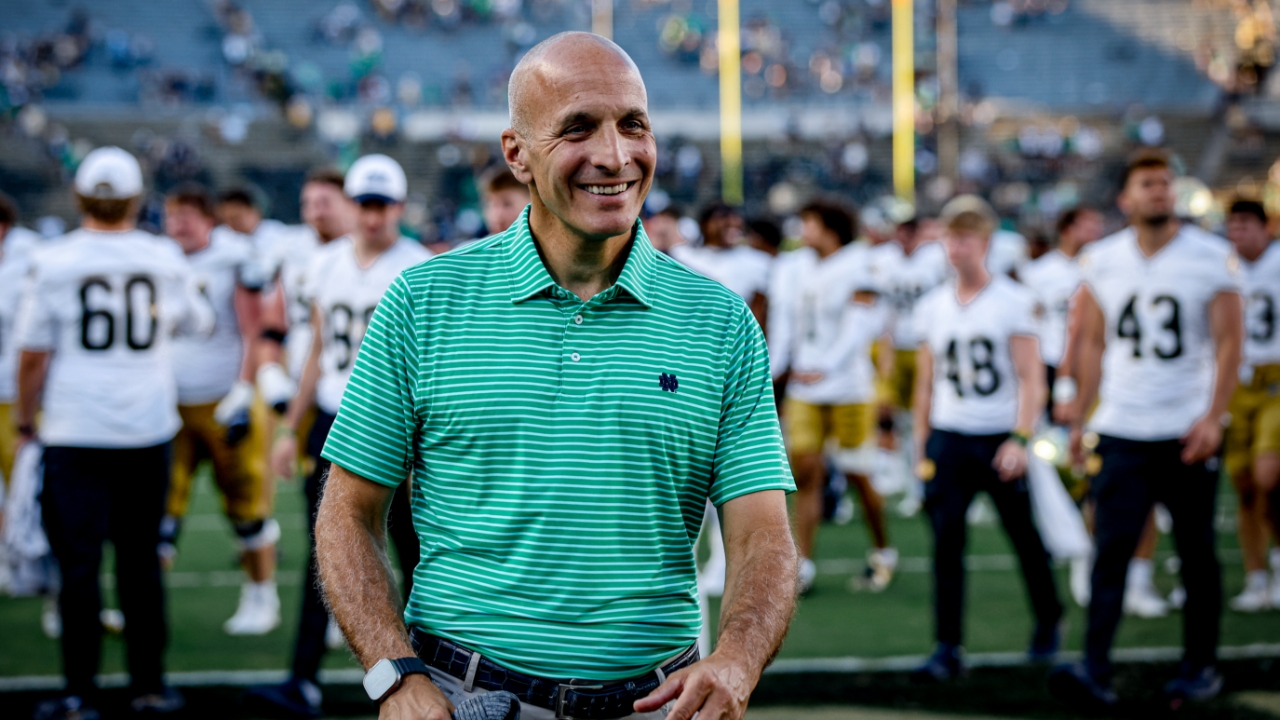
Notre Dame athletic director Pete Bevacqua spoke with a small group of local media on Tuesday afternoon to cover all aspects of Fighting Irish athletics.
This interview has been edited for length and clarity.
On his summer activity:
Bevacqua: “I would say I mean so much time has been spent really, not just recently but over the last year, year and a half, preparing for the House Settlement. What that would mean, what it would look like, creating an NIL department within the athletic department, talking about the cap and preparing for the cap, that $20.5 million and escalating number, making some decisions based on that and the economics of that. Aaron's (Horvath) been such a great partner in this.
“A lot of time in D.C. and talking to D.C. We're proponents of the House settlement. We believe it could create some great stability, but there has to be tea to it and talking with various senators and members of Congress about what we view, what we think is needed in terms of moving forward in this world post-House Settlement - things like these individuals, these young men and women, are student-athletes.
“We believe firmly that they're student-athletes. Everything we try to do here is to create and maintain a truly integrated student-athlete experience, so we believe they're student-athletes and not employees. Antitrust exemptions, the ability to create some stability, to talk to our student-athletes and keep a good thing moving forward and also what are the mechanics of the clearinghouse with Deloitte? What are the repercussions for those who kind of try to operate outside of the system? We've been having those conversations literally on a daily basis with D.C., and I think making some progress there for sure.
“I'm in the process now over the course of the last few days and this will go through this week and into next week, meeting with each of the head coaches and the sports administrators, talking about last season, talking about the summer, talking about the upcoming season expectations, how they're feeling about things.
“And then, no secret, you guys know Notre Dame so well, what's going on in the university ether across the country. Some real headwinds right now when you think about things like the endowment tax and the freezing of some federal grants. You've read the news about Notre Dame with the hiring freeze and some budget cuts and really working hand-in-hand with university leadership to navigate through that, particularly for, in my case, how it relates to the athletic department.
“Obviously, our president, Father Bob (Dowd), has been a wonderful partner there, Shannon Cullinan and our own finance team. There's real headwinds now and how do you keep moving forward? How do you keep progressing? How do you keep serving the needs of our roughly 740 student-athletes as best we can in this environment? We're committed to that. So that's been taking up, I would say, the largest chunks of time in addition to the everyday responsibilities that you have in this role.
“Something that I love to do, whether it was at my time when I was the CEO of the PGA or, running NBC Sports, I love meeting with our team. There's certain people I meet with, talk to 50 times a day, like Aaron, or Ron Powlus, or Jenny Borg. But conducting a series of breakfasts with different members of our team will come in here, usually 10 or 15 of us. I've done this over the course of the last year, do it every other week. I always love to hear their story, how they got to Notre Dame. Everybody has a different story. It's always fascinating and you get to know each other really well. I do the same thing.
“I'd say the most enjoyable part of my job, probably the main reason I'm here, is I love the interaction with student athletes. I don't go a day without meeting with student athletes, talking to student athletes, either one-on-one. I do a similar thing with breakfasts with student athletes. Every other week, I'll get a group, purposely from different programs, different sports, we'll go up to the suite in the stadium and sit down and have breakfast. Same type of thing, just keep it purposely informal, go around and hear about them, where they're from, why Notre Dame. It's always fascinating to hear the different stories, the different paths that they've traveled to get to Notre Dame.
“I feel it's my responsibility to try to truly get to know each one of our student athletes. There's a lot. There's one of me, there's 740 of them, so it's tricky. I interact with some more than others, but I like to think over the course of the year, I try to have a conversation, try to get to know as many of them as possible.
“I think that's one of the most rewarding parts of this job. When you start to think about the pressures of the current college landscape, the future of college sports, I find that every time I have a discussion with one of our student athletes, you leave that motivated and more committed than ever to what we're trying to do here.”
On how he maneuvers the NIL/revenue sharing world while allowing fans to experience the same game they’ve fallen in love with over time:
Bevacqua: ”I think it's important for people to realize that it's not as though just a switch has been flipped on. Student athletes, particularly in certain sports, and primarily, it's no secret, football and men's and women's basketball, have been earning money through name, image and likeness opportunities for several years now. We're already in that age of athlete compensation based on opportunities around name, image and likeness. When you show up to your first Notre Dame game this year, it's not as though there's going to be a tangible difference. We're already existing in that world.
“I think the main, one of the main components of the house settlement, as I view it, it's really a movement of the economics of that from the collective world, largely up to this point, unregulated collective world, and in many instances, the wild west of collectives, into the university system. I think that's a very good thing. The main difference, as all of you know, is now for the first time ever, universities will be able to directly compensate student athletes up to that cap amount, that $20.5 million amount, where it will start.
“But athlete compensation, particularly for those revenue sports, that's been out there. Locker rooms have dealt with it, and coaches have dealt with it, and whether it's Marcus Freeman or Niele (Ivey) or Micah (Shrewsberry), they're used to interacting with that and dealing with that. I don't think it's going to be any striking difference in that regard at all.
“My biggest concern from your question, in terms of what makes college sports special and could that change, I think primarily around college football. College football is a big business, right? When you think about 80,000+ spectators in our stadium, when you think about our relationship with NBC, when you think about the college football playoffs. But yet, it's been able to maintain all those elements that make it special.
“I think you read and you hear and we've been approached with these concepts, largely circulated by private equity firms about the creations of super leagues. I view that as almost the formation of a version of an NFL paradigm. To me, that would spell the end of what makes college football special. If college football tries to imitate or replicate the NFL, it's going to fail. It’s going to end up looking more like a minor league sport, a somewhat bastardized version of the NFL than the NFL and we're going to lose everything that makes college football special. These are young men who want to come and be students at Notre Dame and excel in the football field. Hopefully, do their best to excel in the classroom and have that fully integrated student-athlete experience.
“If we move away from that and it becomes all about, let's get the 30 or so brands that really move the needle and create some version of the NFL, I think we're going to ruin something that's really, very, very special to this country.”
On how significant a push there is to move to an NFL model:
Bevacqua: “I think the good news right now is it's working. I look at the season we just came off of. It was a great season for us, right? So maybe that kind of influences my opinion. But regardless of Notre Dame and Notre Dame football and the success we had, it was a great season with an unbelievable CFP and 12 deserving teams. We had some great success. There was one thing I changed about that CFP run, but Ohio State was a heck of a team. But it was a great season.
“There were so many storylines and there was so much interest and so many schools involved to the very end who could have earned their way in there. Whether you have two teams in a playoff format or 100 teams in a playoff format, there's always going to be somebody on the outside looking in. But that adds to the intrigue and adds to the narrative.
“I think we have some real balance. I think we're starting every year where there's a large number of teams that can make a real great run at a national championship. I said it last year before that CFP, I think you had 12 teams in there that could have won it if things broke their way. You've got to be good. You've got to stay healthy. No matter how good you are, you're going to have to get lucky here and there. I think college football right now is really healthy.
“I think with this house settlement and with the cap and with some regulations around collectives, I think we could be entering into a period of stability. I think conference realignment has seemed to stabilize a bit with the changes that have been made over the course of the last few years. With my past, I can speak to this; there's tremendous media interest in college football. I personally think it's the second strongest media product in sports behind the NFL and we've got to keep it going.”
On when he officially got into the mix with CFP discussions:
Bevacqua: “ I shadowed Jack in those CFP meetings once I started here, but the CFP model was completed. The process of going to the 12-team format last year was completed. When I got very involved in that transition from Jack (Swarbrick) to me, the first thing that I was dealing with was the negotiation of the new CFP deal in terms of Notre Dame, but also in terms of the extension with ESPN.”
On what is the best CFP format for College Football and Notre Dame:
Bevacqua: “We believe that what's in the best interest of Notre Dame is what's in the best interest of the long-term health of college football. We don't look at this like what's the best situation for us in 2026 or 2027. What's going to be good for Notre Dame and good for Notre Dame football is healthy college football and a healthy CFP for the foreseeable future, for the six years and hopefully well, well beyond that.
“I think one of the benefits of Notre Dame and one of the benefits I have is that we have such a consistency of leadership. When you think about Notre Dame presidents, that movement from Father Hesburgh to Monk Malloy and Monk Malloy to Father Jenkins and now to Father Bob. I'm able to have conversations with Father Bob, not about the next one or two years, but about what's in the best interest of college football and Notre Dame football for the next 25 years. That's how we think about it because that's important to the future of Notre Dame, because obviously college football and the history of Notre Dame football is a very important thing to Notre Dame.
“When I think about this next six years and that six year extension with ESPN as we move beyond this upcoming season, first and foremost, we have to do everything we can to get, whether it's 12, 14 or 16, the very best teams in the CFP competing against each other trying to win a national championship. We'll do everything we can to earn our way in and prove it on the field. That's the goal.
“Credit to our football program, credit to Marcus. We lose that game to NIU, we can have a lot of wiggle room. With his leadership capabilities and the culture of that team, to be able to turn that into something positive was remarkable, and we earned our way in.
“I happen to think that there should be automatic qualifiers for the Power Four Conference champions and there should be an automatic qualifier for the highest rated G5 champion. But then, whether it's 12, 14 or 16, I think you have to earn it on the field and those should be at large berths. If we're one of them, great. If we're not, we'll try like hell to make it the year after. But that's the goal.
“I think that's the best way, the most repeatable way to get the very best teams to compete for a national championship year in and year out. I think most people agree with that. Both the decision makers, the general public, football fans. I think that's what people want to see. Year in and year out, you want to identify the best team in the country and that's the goal. We have to be guided by that goal.”
On finding the best teams for the CFP while not always having balanced schedules (Indiana):
Bevacqua: “I can't speak for any of the conferences or certainly for any other team, but there are a lot of teams playing big-time college football. Again, we're not the NFL. The NFL does everything it can to balance power, whether it's salary cap, whether it's the way the draft is constructed and they've done a remarkable job of that. There's wonderful teams in the NFL. There's superstar players that pop like a Patrick Mahomes, but there's great parity. I think that's a credit to the NFL system and to the teams and to Commissioner Goodell.
“College football is different. Like, we're never going to play the same exact schedule. We're never going to, unless you create some super league where you get the 30 best teams, put them together, create two divisions and have them have at it. But that to me spells the end of college football as we know it.
“We're a perfect example. We have to put an incredibly competitive schedule together. If you look at the schedule we have this year, opening up with Miami, then we blink and we have a great Texas A&M team coming here. We have USC. We have Boise State. We have a really strong schedule and that's key to us. Whether you're the ACC, the Big 12, the Big 10, the SEC, their conference games and the strength of those schedules, their non-conference games - we luckily have had great success, obviously with the ACC, but also scheduling SEC, Big 10 and Big 12 opponents as well as others.
“There's always going to be a mix. There's always going to be arguments. It's always going to be part of the narrative. I think the selection committee, those individuals, put their heart and soul into this. They're humans, right? They're going to have different opinions, different perspectives, but I think that's part of the process. We're working as a group, the CFP, to make the selection process better and better and stronger and factoring in things, just like you talked about strength of schedule. How can we make that even a bigger factor of earning your way into the CFP? Always looking to improve that process.”
On if there is concern about being able to put together a competitive schedule for the CFP, ticket sales, NBC and fan purposes if the Big Ten and SEC aren’t willing to step out of conference and if it could get harder to schedule Power 4 programs:
Bevacqua: “I would tell you, we feel fortunate. The amount of conversations we have and Ron Powlus does just an amazing job of having those conversations on a weekly basis.
There's a tremendous amount of interest from teams in all of the Power Four conferences and beyond to play better. I think you saw two recent examples of that. The series we announced with Clemson. The conversations I had with Graham Neff over the course of the last few months to get that going, to put that together, we think that could be one of the great rivalries over the course of the next couple of decades.
“I think the Texas example is another great one. I had a meeting with Chris Del Conte. I flew down to Texas to meet with him after talking on the phone a couple of times and it took us an hour to put that together. Chris was like, yeah, we'd love to play Notre Dame and we'd love to play Texas, and to have Notre Dame visit Texas and Texas visit Notre Dame, I mean, in my opinion, that's as good as it gets.
“Our expectation and belief, based on what we know, what we hear, the conversations we're having right now, is that we hopefully can do that for the foreseeable future.”
Want the latest scoop on the Fighting Irish? Sign up for our newsletter and become an ISD Premium Subscriber: Sign Up for ISD
Colosseum Navy Notre Dame Fighting Irish Always Sunny Lightweight Quarter-Zip