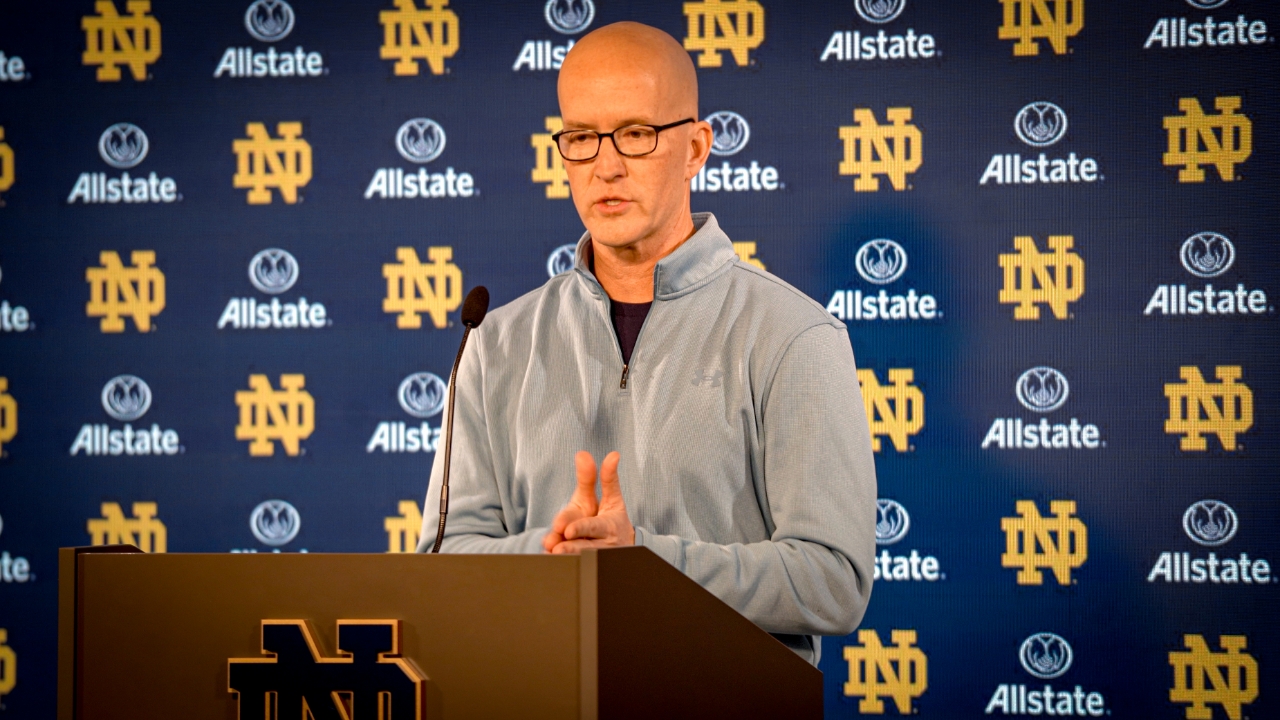
Notre Dame athletic trainer Rob Hunt provided a detailed and extensive look into where Notre Dame's injury report stands entering spring football.
*This is in transcript form to provide a clear picture of Hunt’s updates.
On players who will have modified activity this spring:
“I'll start with three guys that I debated whether or not to even share at all, but you're all going to be here on Friday. They're going to have a little bit of modified activity for us just on the opening. They've got minor injuries.
“Leonard Moore, tweaked his ankle over spring break and so we're just going to protect him through the weekend. Mild deal. He’ll have a full, full spring of activity.
“Chris Terek’s got a foot laceration that's recovering, so we're waiting on the sutures to go there. It'll be modified through the weekend
“Jaden Greathouse, at the end of winter program, had a mild hamstring strain. He's on the back end of that, recovering from that. Again, he's going to have a full spring for himself as we move forward.”
On players who will be LIMITED this spring:
“As we get into limited guys, the remaining people that we have here are post-surgical.
“Drayk Bowen had a labrum repair in early January. It's an injury he had during the season and the timing of it's just post-season recovery there. He's about two and a half months out on that. He's going to have some limited position work and some group work, but he will be non-contact and probably won't have any full-live scrimmage team activity throughout the spring.
“Madden Faraimo had a high school wrist injury. He's been here a year now, but he had a high school wrist injury that's called a scaphoid fracture. About 10-15 percent of these don't ever heal fully and he battled with it most of the season.
“At the end of the season, we kind of determined a plan to best serve him, and it's a complex surgery. They take a piece of bone from your knee off the end of your femur and then replace that along with the vascular structures to the wrist. He had a little knee procedure, a little wrist procedure and it's about a 10 to 12-week recovery. He's at 10 weeks right now. He's in a cast.
“We're going to pull the pin here in a couple weeks and he's going to be non-contact, similar to Drayk, throughout the spring. It's a complex recovery. The recovery is about 98 percent successful, so we feel really good about that. It kind of decreases as they're going to have a great summer, but we'll be modified through the spring.”
“Kahanu Kia had a left knee scope about two weeks ago, just a cleanup procedure on his knee. Expect him, in a couple weeks, to be back fully with our defensive side of the football.
“Tyler Merrill had a labrum repair on his shoulder. He's about 4.5 months out. It's about a six-month recovery for what his procedure was. He'll be out for spring and he'll be kind of in limited drill work, but he's not going to be doing any team activity or any contact stuff.
“We're going to continue to build his strength. The good part for us is we were able to capture him kind of at the back end or the middle of his rehab process, so taking over that's been a good thing for us in terms of getting him ready for a full summer.”
“Aneyas Williams had a post-season elbow surgery. He's about eight weeks out on his elbow surgery. Had a muscle repair and a ligament repair there. He's doing great. He's in non-contact. He's going to do plenty of drill work, some seven-on-seven type of activities, but he'll be non-contact and no physical activity with that arm, per se.
“He'll be marked with a red jersey to protect him and he'll get plenty of work, and he's in a really good spot for himself relative to being full for the summer.”
On players who will be OUT this spring:
“Khary Adams, on his physical exam that he had when he got here, we identified a labrum tear in his shoulder as well as an unstable shoulder, and so we wanted him to go through all of our winter program. He had the full winter program and then we timed it up right before spring break so he had limited academic misses there for himself. It's going to be a 4-5 month recovery, so timing for him is perfect. He had a great off-season program. Now he'll recover from the shoulder and be full for us come midsummer and not have any problems with that as he enters into fall camp.
“Jakobe Clapper had a la brum repair just before he arrived here on campus, actually the day before. He's about 2.5 months in, so he'll be out for spring and have a full summer.
“Ashton Craig is 4.5 months in on his ACL that he suffered last season. He's in a really good spot. He's really, really attacked his rehab, and he's in a really good position right now building strength. This is ACL number two for him. I don't know that that kicks out of his timeline any longer, but it does probably slow down a little bit of the strength gains that we're able to capture relative to a single ACL. He's going to have a good summer as he builds strength and transitions or returns to play, he'll be back for the fall there.
“Tiki Hola had an ACL injury late in his high school season. He's three months in on his recovery, so he's rehabbing with us. He's going through our winter program modified and will be out for the spring.”
“Javian Osborne just arrived in January. He has a similar injury to what Madden had. He went through our winter program, and he, too, had a complex wrist procedure, so took the femoral condyle part of the bone, restored that back into his wrist along with the vascular structures. He's on that 10-12-week recovery as well. He'll miss all of spring, and we'll have a healthy wrist when we enter into the summer.
“Quincy Porter had a knee injury during his time at Ohio State. He had this surgery as he entered into the portal. He's about 10 weeks in and beginning his RTP process along with his rehab side of things. He'll miss spring, but we'll have a full summer of activity and I expect him to be full for the fall camp.
“Brayden Robinson had a late-season high school ACL injury. He's four months in and progressing nicely. Really glad that he's here with us in our rehab process. Expect him to do really well here over the next couple of months and have an unrestricted summer.
“Gordy Sulfsted is 2.5 months out on a labrum repair for his shoulder. That was a post-season repair for him, so he'll miss spring and enter into a full summer as well.
“Kyngstonn (Viliamu-Asa) is three months out on his ACL injury. This is ACL number two for him. He had one in his sophomore year of high school, so that's a little bit challenging in terms of your graft site choice, but he is doing really, really well. We did some testing yesterday, and he's in perfect position for three months in relative to his strength gains.
“Expect him to be really active in the summer and if he builds his strength and continues to move the way we expect him to do, then he will be somewhere in the early fall stage, maybe training camp. But again, that timeline is going to be based off of his recovery timelines and recovery milestones that we expect him to hit.
“Kedren Young is a little bit over seven months out and is in a great position. He's not going to do spring ball, but he's in an active return-to-play progression with myself and our strength staff. His strength looks really good right now and he's just got to move through our change of direction, running, all those types of activities as we go through the next couple of months, and the hope is that when he returns to campus in early June that he has a completely unrestricted summer and he's ready to go for fall camp.”
On OL Charles Jagusah:
“Everyone knows that he injured himself over the Fourth of July weekend and had a really severe injury to his humerus. I'm going to explain in a little bit more detail.
“He's had a bumpy road relatively in terms of that recovery. It's a complex injury and a severe injury, and he's just had ups and downs through it. He's had four subsequent surgeries. He's got a final surgery today, but he had the injury itself. About two weeks afterwards, he had a clean-out procedure just relative to his wound closure, so that was surgery No. 2.
“In September, the hardware due to the bone not healing failed, so the hardware was exchanged in September, and we were hopeful at that time that the injury would begin to heal. It did not.
“In January, the hardware was taken out again, and we were able to identify some infection that was in there probably from the initial injury. He's gone through extensive antibiotics and antibiotic seeding into the bone. That hardware now is going to go back in, so the bone will be grafted again today, and we're extremely hopeful.
“We're really optimistic. We think that the infection was probably inhibiting some of his bone growth, and now he's in a position without infection. The bone will be grafted and stabilized and this will allow him to fully heal. He's got more to go. There's a lot more rehab involved. There's a lot more time that he's got to put in there, but he's gone through a lot.
“And, again, we're really optimistic. We do think that he'll return, but his timeline, as we kind of shared at the early onset, is undetermined at this point. Once his bone heals and his muscles are strong, we'll enter into the return to play side of things, but really optimistic there.”
On if it’s rare to have complications with Jagusah’s injury:
“I think the challenge for Charles was it was an open fracture with a pretty sizable wound that he had. The physician in Wyoming spent 2.5 hours actually cleaning the wound out before he even began to fixate the bone and then he spent another two hours working on the bone.
“It wasn't a failure in any way relative to what he did out there. It's just the fact you get that much debris and soil into your body, you just don't know what's in there, and even as hard as they work to clean it out and spend the time to do that, the challenge is identifying the organism that's stopping it and then getting the proper antibiotics going with that.”
On supporting Jagusah mentally:
“Charles is a strong-minded guy. He's been through a lot. He's had some low times. When you think you're moving forward and you're where you want to be and then you have to step back, that's hard to take on. He's relied on his teammates and his coaches. Our sports psychologist has worked really well with him and it's been really beneficial. The growth is in the heart and Charles is definitely equipped to handle that and has done a really good job managing those emotions and that bumpy road in terms of his return.
“Yes, I'm an optimist, so I think it's when he returns. I won't ever stand up here and take that away from any one of our guys unless we're absolutely certain that it's impossible for that to happen, and I do believe that. I think there's a strong chance that he's right back where he was. The hard part is you make up all this lost time. You're never going to get that back. He's a well-developed, super-strong guy, played a lot of football, and so he's got some benefits there than a young training age that doesn't have those strengths.”
On what is inside the medical tent:
“I think for us the medical tent just provides a little bit of privacy. Prior to having it, it was with guys standing around there holding up towels and doing all that business. There's a motion in being injured, and our goal is to get an accurate and quick assessment of what's happening. That's priority number one, what's going on here. The next step is what are we going to do with it, what do we need to do next to either evaluate the injury further, do we need x-rays, do we need additional physician involvement, and then coming up with a plan and assessing and demonstrating to the individual that they are safe, they're ready to go or not ready to go back into play.
“That contained environment is important that we are able to get the athlete centered and focused on what we're trying to do and come up with a good assessment. That's probably the biggest thing. The worst thing for us is too many people in the tent. We actually had a larger tent at one point, and I wanted a smaller one so fewer people were in there.”
On if schools exchange injury info when players transfer:
“That's hard. The biggest thing is you've got to get permission from the athlete to acquire those records. Once that happens, most places are pretty quick. We're all in the same game here. We're all trying to acquire that information as quick as possible to make that continuity of care is well delivered. Some places do it better than others, and some places don't have really detailed records, so that's a little frustrating. But you just try to put together as much of the information as possible to allow yourself to best serve them moving forward.
“You do it also for our high school kids. The process is set for any athlete that we bring here. We're trying to gather all that information as much as possible because as we examine them, the story that you may get from your patient directly in front of you might not be exactly what happened three or four years earlier when they were 14, 15, 16 years old. From a concussion side of things, it's no different than any other injury piece that we try to acquire.”
Want the latest scoop on the Fighting Irish? Sign up for our newsletter and become an ISD Premium Subscriber: Sign Up for ISD
Under Armour Kelly Green Notre Dame Fighting Irish Premier Football Jersey