Notre Dame basketball has made the NCAA Tournament just once in the last nine years.
The program’s most recent appearance came in 2022, when the Irish nearly made a miraculous run to the Sweet 16 after starting in the First Four in Dayton.
Now, the NCAA Tournament feels like a pipe dream given the program’s current status under Micah Shrewsberry. Notre Dame failed to qualify for the 15-team ACC Tournament this season, a troubling sign for a program still searching for traction.
At this point, Notre Dame’s lack of success comes down to a few key issues:
- No culture
- No discipline
- Lack of trust
The culture issue is perhaps the most evident. Simply put, Notre Dame doesn’t know how to win.
The Irish failed to win consecutive ACC games this season, and the program is still searching for its first Top 25 win under Shrewsberry. Injuries certainly played a role. Markus Burton missing significant time and Jalen Haralson sitting out several games made it difficult to build momentum.
Still, this has been a recurring issue throughout Shrewsberry’s three seasons in South Bend.
Coaches often talk about not getting too high after wins or too low after losses. Yet there have been multiple press conferences following victories where the tone suggested the program had turned a corner, when in reality the win came against a mid-major opponent or the worst team in the conference.
That’s not to say Notre Dame shouldn’t enjoy its wins. They absolutely should. But the lack of a consistent winning culture is becoming increasingly evident.
Discipline is another area that must improve if Shrewsberry is going to turn things around.
Is it on the coaches? Is it on the players? The truth is, it’s probably both.
The coaching staff has to teach good decision-making and situational awareness. At the same time, the players eventually have to execute.
Notre Dame has now lost multiple games in late-game situations involving fouling while leading by three. Earlier in the season, the Irish attempted to foul and failed to execute. Later, following the Cal debacle, they lost a game by not fouling in the same situation.
Earlier this week against Stanford, Shrewsberry criticized his team for failing to execute defensively in the closing minutes.
At some point, the players simply have to make plays.
Trust is another issue that shows up at times.
If you watch Shrewsberry on the sideline, he’s constantly directing his players, particularly on the offensive end. At times, it looks like he’s moving pieces around a chessboard in real time.
Eventually, the players have to be allowed to play.
Constant direction can add pressure and cause players to overthink what they’re seeing on the floor instead of reacting naturally. That’s not to say this group shouldn’t be coached, or even overcoached, but overprocessing can slow decision-making and hurt execution.
The good news for Notre Dame is that there is still a core group Shrewsberry can build around.
It starts with a healthy Markus Burton and Jalen Haralson. Both players are capable of attacking the rim whenever they want, which is an invaluable trait. Each has already proven they can score at a high level against quality competition.
The key question heading into next season is how they will function together. If Haralson improves his jump shot, the offense becomes much more dangerous and adds another weapon for Burton to find when he has the rock.
Cole Certa and Braeden Shrewsberry also remain valuable pieces, especially if Notre Dame continues to rely on isolation offense. Both should see plenty of open looks next season with Burton and Haralson drawing the attention of defenses.
Neither will be relied upon to anchor the defense, but their ability to shoot can significantly impact the offense.
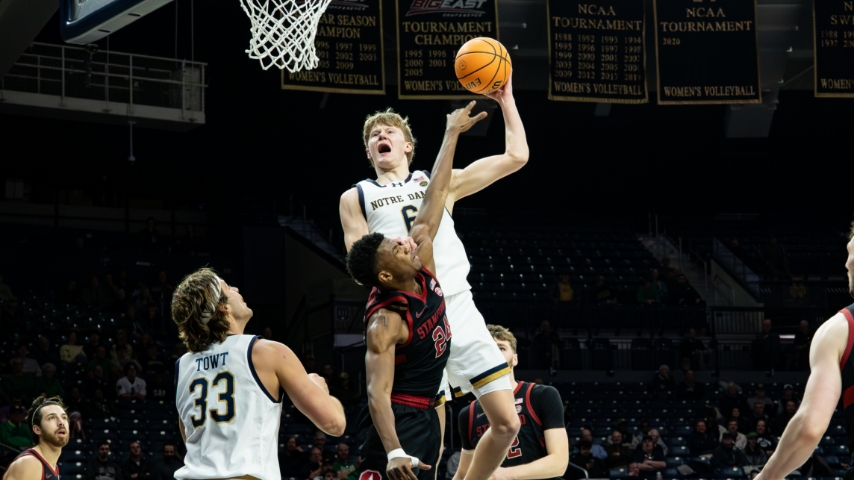
Perhaps the most important piece on the roster is freshman Brady Koehler.
The Indiana native represents something Shrewsberry hasn’t yet had at Notre Dame: a skilled big man.
Koehler flashed his potential multiple times this season, showing the ability to score in the post, stretch the floor with his shooting and protect the rim defensively.
More importantly, he’s a player capable of taking a major step forward.
If Koehler can consistently become a scoring threat on the block, Notre Dame’s offense gains an entirely new dimension. The Irish would be able to play through the post, creating opportunities for Koehler and shooters when defenses collapse.
Koehler also recorded 22 blocks this season and had multiple games with more than two steals, showcasing his defensive ability.
He’s a player the program can build around and it will be on the coaching staff to continue developing the 6-foot-10, 205-pound forward over the next eight months.
College football recently held a roundtable discussion on fixing the sport after President Donald Trump invited several prominent figures to weigh in.
There was just one problem.
There was no real substance. The entire event was a show rather than a serious attempt to solve the sport’s problems.
If college football truly wants meaningful change, the conversation needs to include commissioners from every conference along with a handful of respected voices across the sport — not a room of 60 people ranging from Nick Saban and Urban Meyer to Greg Sankey and Pete Bevacqua.
The optics of the discussion were also hard to ignore.
Saban has suddenly become a vocal advocate for change, yet he spent the majority of his career benefiting from a system where players were not legally allowed to be paid. How has Alabama performed since the NIL era began?
Many of the voices involved in these conversations continue to miss where college football is actually hurting itself.
It’s not the occasional horror story of players being sued by schools or collectives, or even a few athletes making massive amounts of money.
The real issue is the Transfer Portal.
Players should absolutely have the ability to move schools and pursue better opportunities. But there also need to be guardrails. Players playing at four different schools ultimately doesn’t benefit the athlete or the program.
A simple solution exists.
College football should adopt a true one-time free transfer rule.
That approach is fair and realistic. Thousands of non-student-athletes make the wrong college decision every year and transfer elsewhere. People mature. They learn what environment helps them succeed.
And student-athletes should also be allowed to transfer freely if their head coach leaves.
Will that always be the right decision? Of course not. But a head coaching change dramatically alters a program. Imagine committing to play for Marcus Freeman and suddenly finding yourself playing for Brian Kelly instead. Position coaches move all the time. That’s part of the sport, but a head coaching change is a far more significant shift.
Outside of those scenarios, the portal should largely close unless a player becomes a graduate transfer.
That structure still provides athletes with flexibility while preventing the constant roster turnover currently plaguing college athletics.
At the same time, the conversation about restricting student-athletes from making money is almost comical.
Many of the same people calling for limits have built enormously successful careers and fortunes on the backs of the athletes they now want to restrict.
If the real concern were education or player well-being, the conversation wouldn’t include expanding the College Football Playoff to 24 teams.
That isn’t about academics or protecting student-athletes.
It’s about lining the pockets of the same people claiming to protect the sport.
Want the latest scoop on the Fighting Irish? Sign up for our newsletter and become an ISD Premium Subscriber: Sign Up for ISD
Under Armour Navy Notre Dame Fighting Irish Hockey Leprechaun Fleece Hoodie