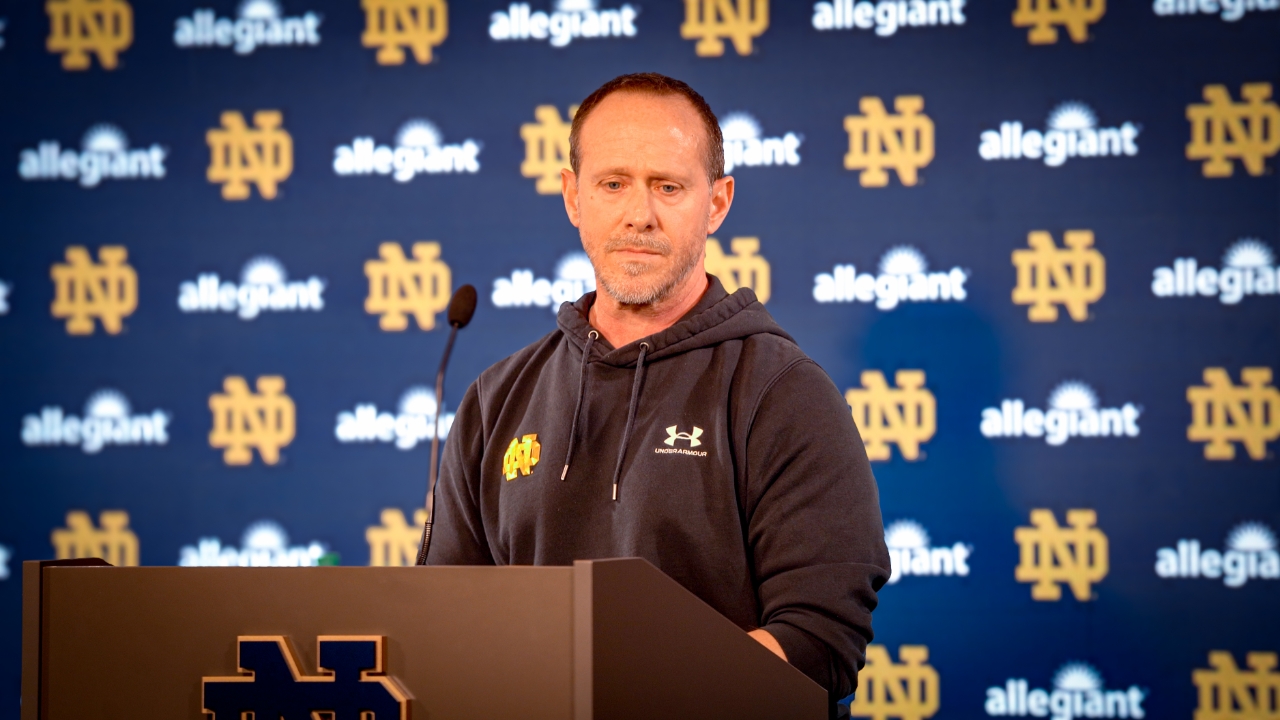
Loren Landow, Notre Dame's Director of Football Performance, spoke on Wednesday afternoon to provide an update following winter training.
On why Aamil Wagner, Malachi Fields and others decided to train with him for Pro Day:
”I think it was something that really started off last year, where we had a few guys stay around, one being Jack Kiser, and guys knew it was a no-brainer for them, especially if they're enrolled as master students, hat they want to stick around here. They ran it by their agent. I did NFL Combine prep for 18 years, so I've been pretty deep rooted in. I think it was just a natural fit.
“We have give and take on the day about 13 guys that have stayed back to train, and those just happened to be two of the guys that were invited to the combine. So you prepare them for the combine. You prepare them actually, first for the bowl game, and then you prepare them for the combine, and then lastly, you prepare for Pro Day.”
On if the players hire him through his performance company or a perk as they are Notre Dame players:
“Four and forever.' Our whole thing is we want to, we want to be able to offer the service to the athletes that they can get without spending a lot of money. They can do it here for free with us.”
On where DL Francis Brewu’s strength compares:
”That's a pretty impressive bench press that I think made its way viral. He's strong on the upper body. No two ways about it. He's strong total body. I try not to get too excited about those things because it's one aspect of performance, but when you see that in front of you, and it gets the room excited, I mean, those are the things that, obviously, everybody wants to talk about. But there's so many great things that he or the other guys are doing behind the scenes, on the training side, outside the strength side, the movement and the band and the burst, these are just really impressive that you see out of a young man like that.”
On the process of figuring out the ideal playing weight or target weights for players:
“It's fluid. Guys come in at a certain body weight and I think a lot of people put it in their head, ‘I need to be this weight to play at this position.’ What we do is we talk amongst our performance verticals. We discuss what is realistic in a certain time frame. We talk to the position coaches and the coordinators and say what's realistic for them to do their job, but also keeping in mind that the age that they are at the developmental level, you want to make sure that you don't receive too much weight too soon.
“Some of the closest proxies I'll use is I start to look at, if I see a vertical jump decreasing as they're adding on body weight, then I know performance is probably going to start to decrease as well. So you want to be smart in how you're putting on the weight. You just don't want to do it indiscriminately.”
On why the freshmen class didn’t have a completely culture shock during winter training:
“I think every off-season is a different journey. Obviously, last year our runway was a little bit shorter, being the national championship year, is a little bit shorter. This year, we had a little bit longer runway. With that being said, when we bring in the freshmen and the transfers, we make sure that they're on their own cadence for the first four weeks. They have to learn what we do, how we do things and how we operate, what our expectations are and what our standards are from a team perspective, but ultimately also how we train and how we prepare.
“So we set that aside for four weeks, and then after that four weeks, we introduce them with the rest of the team. So by the time they're with the rest of the team, they're not trying to compete with the guys who have been here for three to four years and trying to keep up with their weight. They're working within their lane, but they're learning our process.
“People talk about winter workouts, right? Everybody asks questions about winter workouts. I call it winter training. To me, a workout is what you do singularly. It’s one day. It's a bike ride, it's a sweat, it's calorie expenditure. To me, training is, is a path that we have that has a destination, that has a target that we're looking for, and so they understand, they learn it early, and then when we bring them in to everybody else it’s an easy fit.”
On how he builds team culture:
“I think it comes down to number one, my job is to echo the leadership of my head coach and our coordinators and our program, first and foremost. Then it's really holding true to the standards being consistent with the standards. I think everybody can shout standards and talk about it, but you have to really, like implement and police it, and say, here's how we do it.
“Ultimately, it comes down to our players. Our players police the standard and really what it means to be a Notre Dame student-athlete.”
On tweaks made to winter training:
“Really it's just the longer runway that we have. If you look at last year's path, we had some of our players that got about two and a half to three weeks of true winter training before we got into football specific work. So the runway has been a little bit longer in eight weeks. So I'd say that's one of the biggest things, is we're building a broader foundation and going back into that word: development. That’s what this whole thing is about.”
On which returning players made the biggest strides this offseason:
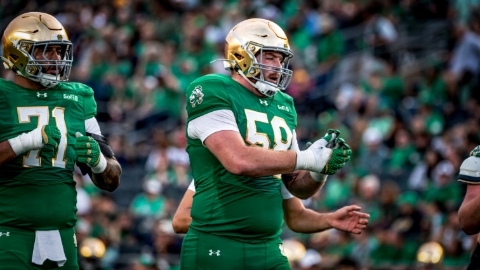
“I do hate to single out guys, because we're so early in the process, right? A lot can change. We're eight weeks in. I look at that from a unit level, and I look at what our bigs are doing. Our O line and our D line, it's really impressive how strong they're getting, how well they're moving as big players.
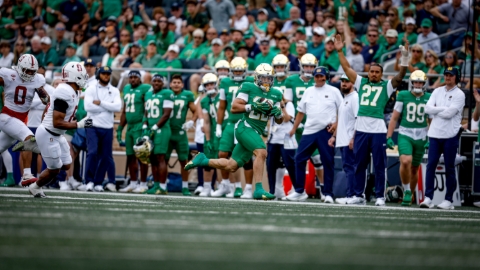
“But then I look at my skills and my mids, and I sit there, and I look at the field and I watch them in our football schools, and I watch how they're moving. They're moving more efficiently. There's a better speed to them. We're eight weeks in, but collectively as a whole, like it's really hard to single out one person and we're so early in the process.”
On the outside perception that injuries are his fault:
“This is a chaotic, physical, violent sport. It is. I don’t know what else you want.”
On the narrative on the outside being injuries are his fault:
“Yeah, that’s for the outside to paint that picture.”
On what Brewu topped out on for his bench:
“475, but he had more in the tank.”
On the process of bringing injured players back:
“I can talk on the general side. Rob (Hunt) and I communicate all the time. We're fluid in our communication and we have multiple meetings in each day, discussing guys from within those situations. I don't run with anything without getting the OK to be able to move them forward. And then back and forth, I'll tell Rob what I see in my room, and we just communicate back and forth and and we use our testing metrics to let us know if we're kind of trending in the right direction.”
On weight gain issues for DE Loghan Thomas and how much extra work he puts in to get those players up to speed:
“That’s a good question and if she were here I’d have Alexa Appleman handle that one. That’s someone we’ve discussed and looked at strategies to help with that. The great thing from my room is he’s strong, he’s explosive, he has all the burst, he has all the strength. Some guys just struggle to put on weight at different times in their careers.”
On how to get freshmen who arrive in June up to speed:
“When you do have them in January, you have all this opportunity to prepare them, and I think part of that preparation part is the physical side, but it's also the mental side of dealing with classes and how to budget your time. I think when we look at the summertime, our goal is to really let them know, here’s the expectations at Notre Dame, and here's how we're going to do things. So you’re microwaving that summer development a little bit to prepare them for getting ready for training camp.
“I would say in my two seasons like we've done a good job of getting those players ready for camp, and ultimately, to be able to help us if we need them.”
On what he looks at to determine an explosive football player:
“I think there are gold standard numbers that help you identify and help you look at 1,000 different prospects and say, ‘this person has a high ceiling; this person has a low ceiling.’ I always tell my guys when I'm preparing them for the draft, or any aspect of testing. I look at the vert, the broad, the 10, the 20 and the 40.
The bert and the broad show you just bottom line, raw explosiveness. That gives you an idea of what their genetic makeup is. If I have a defensive back and I have one guy who jumps 38 and another guy who jumps 34, I know the guy who jumps 38 has a higher ceiling for athletic development. And so when you're making big decisions off of a lot of players in the calendar year, it's an easy dividing line to be able to sit down say, ‘potential and maybe he’s hit the ceiling.’
“I think you bring up a very good point. I love the question was asked about the 40-yard dash. People always ask me ‘How do you prepare guys?’
“You have to have them understand the context of time. I actually have my stopwatch, and what I do with my guys, day one, I have them hit start and stop as quick as they can. Right there, I just did with my thumb as quick as I could. That's two-tenths of a second.
“I grab a skill guy and say, that's the difference between you running a 4.6 and a 4.4, what I just did with my thumb. When I provide context of time to a race that we don't have context for, it gives you an idea that there's not a lot of difference between a guy who does run the 4.6 vs. a 4.4. I try to build that context in right away in the training process.”
Want the latest scoop on the Fighting Irish? Sign up for our newsletter and become an ISD Premium Subscriber: Sign Up for ISD
Antigua Pink Notre Dame Fighting Irish Desert Dry Dogwood Polo